Tuesday, October 13, 2015

Mushrooms

We recently added a few more logs to mushroom log stack.  This time we put in some Ash instead of Oak.  It will be interesting to see which does better.

From 2015-09-21

We put foil tags on the end so we can remember that they are innoculated with Warm Blue Oyster spawn in  September 2015.  Looking forward to tasty mushrooms in a few months.

From 2015-09-21

Monday, October 12, 2015

Wildflowers of Southern Middle Tennessee

I didn't use to pay too much attention to flowers. I liked them and didn't have anything against them but, other than noticing they were pretty, I didn't give them much additional thought.

However, once I started keeping bees, I started paying a lot more attention to what was blooming during honey season. As I became better at identifying flowers during the honey flow, it naturally led to more interest and curiosity in blooms year round.

In order to not lose my previous work, I've decided to keep a running list on the blog so I can go back and reference what I've discovered so far.

(disclaimer.  These are just my thoughts and observations.  There is a huge margin for error)

The flower below is called "Mouse Ears" or the Asiatic Dayflower.  Despite being kind of pretty, it's considered noxious and an invasive species.  The bloom period Mouse Ears is early September and I haven't seen many of them since.

After checking the wildflower identification site, I found that the bloom for these only lasts for one day, thus the name.  From what I've read, the bees like the color and they can be a food source but, due to their short duration, are probably not very dependable other than for a quick bite.


From 2015-09-17

The flower below is a "Late Purple Aster".  I was happy to see a large number of these start blooming this fall.  There were a lot of them that came on at the end of September and start of October.  They are a small, pretty flower and are very important for late season bee feeding.   The picture below is a little washed out because of direct sun but, to the naked eye, they are nice shade of purple, which you can see in the background blooms.

From 2015-10-04

I think the flower below is a "Bellflower".  They grow on a long stem and seem to be a favorite of the bees.  This bloom showed up around the first part of July.  Apparently it's kind of noxious and not highly desired by anyone but beekeepers.

From 2015-10-04

The flower below is the ubiquitous "Brown Eyed Susan" (or possibly the black eyed).  I'm not entirely sure how to tell the difference.  Brown/Black Eyed Susan are a pretty easy flower to identify and can be found all over in fields and on the side of the road.  Also, bees seem to love them.  The blooms show up around late June early July and seem to last for quite a while, up to a month.

From 2015-10-04

More Brown or Black Eyed Susan.  I'm not sure why the petals are different on the top flower.   Maybe it's a little dried up or something.


I'm not a 100% sure what this is.  It looks a little like Phlox but doesn't match up exactly.  The closest thing I could find was the "Carolina Wild Petunia".  The bloom showed up in late June and with it's blue/purple color and big, open landing pad, looks like it's pretty bee friendly.    I'll have to pay closer attention next year so I make sure what it actually is.

From 2015-10-04

The following two pictures show the Bergamot or "Beebalm" flower.  With a name like that, how could a bee not like it?   They're very pretty but don't seem to last too long.  These blooms showed up in mid-June and seemed to last about a week or two.


Closeup of Beesbalm


The "Woodland Pinkroot" is striking to see in the forest, with it's bright red standing out against all the green.  These aren't really bee friendly since they have a long cylindrical shape that keeps bees out.  Also, bees seem to like yellow and blue and ignore red so they probably don't pay much attention to these.  

The Woodland Pinkroot also have a short bloom period.  These showed up in mid-June and didn't stick around too long.  An additional item of interest is they are supposed to have medicinal properties but can be dangerous if not prepared properly.


From 2015-10-04

There is a lot of "St. Johns Wort" in the forest.   These started showing up in early June.and seemed to have a season of about 3 weeks to a month.    It's more of a bush than a flower and easy to identify by it's bullet shaped buds when not in season.  It's also supposed to have medicinal properties.  Being yellow and with an open flower with lots of landing spots, it's a bee favorite.

From 2015-10-04

The flower below is most likely the "Oxeye Daisy".  It's pretty but not a native species and is considered noxious and invasive.  These bloomed in early June and seemed to have a pretty long life, lasting several weeks.  Although they are white, the yellow center probably attracts bees.  It also has the nice landing platform.  I'd guess the bees probably like these.

From 2015-10-04

Thursday, September 17, 2015

Pole Barn

My dream of getting a pole barn finally came true.  The delivery truck showed up last week and the builders weren't far behind.  Here's the first step.

From 2015-08-10

We had a heck of a time getting the posts set.  It seems we found solid rock under several of the beams.

From 2015-08-10

We ended up having to rent a compressor and a heavier duty jackhammer to get the builders moving again.

From 2015-08-10

After a surprise visit from a building inspector (who woulda thunk you need a permit to build a pole barn in the middle of nowhere) shut things down again, we were able to pay the government their extortion money and get going again.

From 2015-08-10

It was really exciting to see things coming together.

From 2015-08-10

Ta-da!  The shell is built.  The money I was going to use for a concrete floor ended up going to the building inspector, so we're probably going to have a dirt floor for a while until I can build up the war chest again.  But that's ok.  It's not too bad to have dirt.

From 2015-08-10

This is my drive through section and mechanical area.

From 2015-08-10

Here's the barn from the front.

From 2015-08-10

And looking at it down the road.  I just need to paint a nose in the middle and it will look like a face

From 2015-08-10

Wednesday, September 16, 2015

New Wildflower - "Dayflower"

Found a new wildflower called a Dayflower, because the flower only lasts for a day. Apparently, it's invasive and a weed. It's sure a pretty weed though.
From 2015-09-17
dd Here's the official description
From 2015-09-16

Tuesday, August 25, 2015

Late Summer Bees

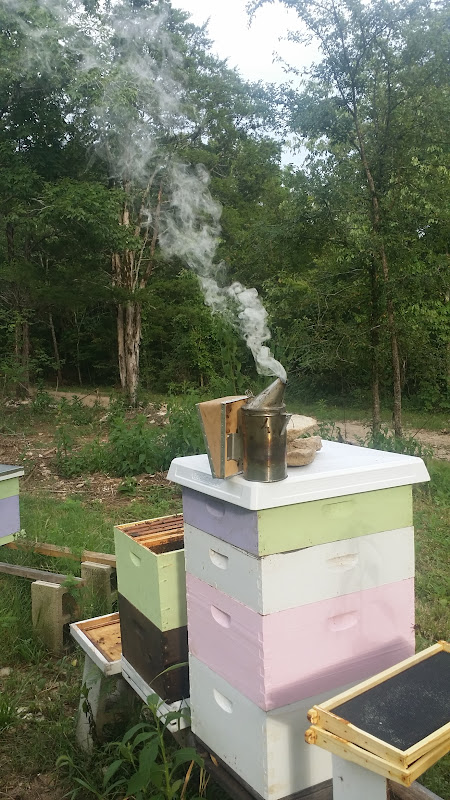
Summer is winding down and the bloom is definitely off the rose.  There is just not much blooming right now so I decided to go out and check on the bees and see how they're set for food.

The strong hive seemed to have a decent amount of honey, but the the split and the nuc didn't seem to have a whole lot.

From 2015-08-10

These are the frames I bought from a local guy who traps bees for a hobby.  They looked pretty good in his yard, so I'm hoping they'll take when I combine them with one of my weak hives that appeared to be queenless.

From 2015-08-10

I also decided it would be good to start feeding the weaker hives so they can stock up some stores for winter.  I've been experimenting with top feeders (shown below) which dedicate the food for the weak hives but require more visits and manual work.

From 2015-08-10

As opposed to a community feeder which can be left for longer periods of time but has no protection for weaker hives.

From 2015-08-10

At this point, I'll probably continue to do a mixture of both.

Wednesday, August 19, 2015

Forest Creatures XIV

Latest Forest Creatures video.  Got some great footage of a deer in velvet, a hawk, and flock of turkeys drinking at a vernal pond in the forest.


Monday, August 10, 2015

How To Inoculate a Mushroom Log

We had some extra time Saturday so Sarah and I decided to make good use of an oak tree I had to cut down for a fence we're building.

We had a few packets of  Warm Blue Oyster mushrooms from Mushroom Mountain sitting in the fridge that needed to be used and this was the perfect opportunity.


After cutting the tree, the first step was to section up the trunk into approximately 2 foot lengths.  Once that was done then next step is to start drilling holes in the log to tap the mycelium covered plugs into.

As you can see, the plugs in the packet are covered with white mycelium, so they should work great.

From 2015-07-15

We started off the drilling by measuring 2" in from the end and drilling a hole the same size as the plug.  Then we drilled another hole every 6" in a straight line down the log.

From 2015-07-15

After the holes were drilled, we followed up by going down the line and gently tapping the plugs in.

From 2015-07-15

After that was done we  rolled the log about an 1/8 of a turn to start the next row about 3" across the circumference and 6" down from the end.

By doing this, we created a star pattern that gives maximum coverage for the mycelium to take over the log.

From 2015-07-15

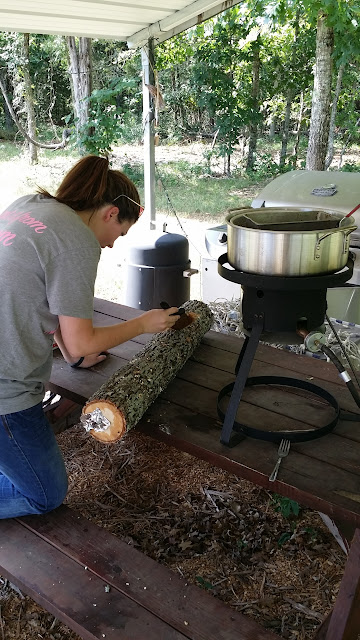
While we were drilling, we got our double boiler going to melt the paraffin wax we'd be using to seal all the plugs we'd recently tapped in.

From 2015-07-15

The purpose of the wax is to seal the hole so insects or competing mycelium don't get in and take over the log before our warm blue oysters do.

From 2015-07-15


The tree we cut wasn't huge, so we made the logs a little longer than usual.  A rule of thumb is that you get a season of mushroom fruiting for every inch of diameter.  It would seem good to get the largest diameter possible.

However, the larger diameter increases the amount of time it takes for the mycelium to fully take over the log. With this skinnier log, we're expecting 6-9 months before we get any fruiting.  With a bigger one it would be proportionally longer, not to mention being harder to lift and handle.

Also, notice the aluminum foil at the end of the log.  We wrote down the date and what kind of mushroom on it and stapled it to the end because, after 6 months, I'll have no idea what we used.

From 2015-07-15

As you can see, the plugs are hard to spot once they're tapped in.  We found it effective to wax them immediately after tapping them so we wouldn't miss any.

From 2015-07-15

Plugs waiting to be tapped.

From 2015-07-15

After a couple hours of work, we got them all done.  We were able to get about 100 plugs put into about 20 feet of oak.  Not a bad days work.  Looking forward to sampling the fruits of our labor. (no pun intended)

From 2015-07-15